Maui's Hook
Polynesian navigators crossed the Pacific using the stars. Not as a rough guide, not as a backup, but as the primary method of finding small islands scattered across the largest ocean on Earth. They memorised rising and setting points of stars along the horizon, read swell patterns and wind and bird flight paths, and got where they were going. Easter Island is 3,500 kilometres from the coast of Chile. They went there on purpose.
The Polynesian triangle, as it’s usually drawn, has Hawaii at the top, New Zealand at the bottom left, and Easter Island at the bottom right. Each side of that triangle is roughly 7,000 kilometres. Inside it are hundreds of islands, most of them tiny, all of them found and settled by canoe over a period of centuries. Hawaii was reached from the Marquesas Islands, 3,200 kilometres to the south. New Zealand was settled around 1300 CE. Easter Island, one of the most isolated places on Earth, was reached somewhere between 700 and 1200 CE, depending on which evidence you trust.
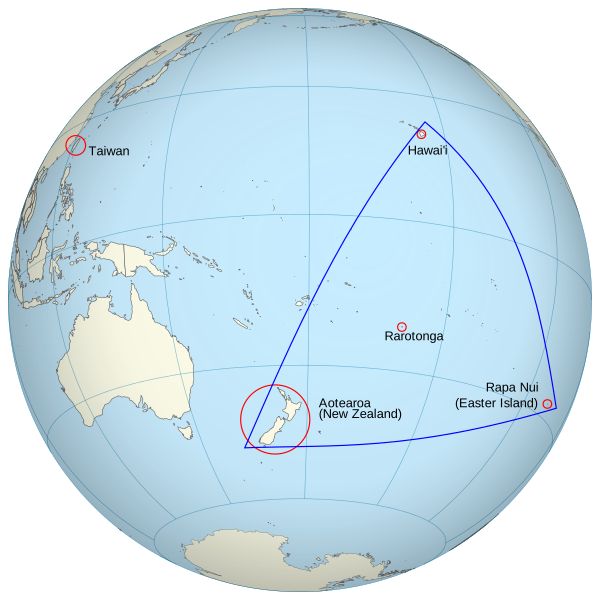
And they didn’t stop there. There’s solid DNA and botanical evidence that Polynesians reached South America before Europeans did. The sweet potato is native to South America, and it was growing across Polynesia centuries before any European ship arrived. Polynesian chickens have been found at a pre-Columbian archaeological site in Chile. Ancient DNA from Easter Island shows genetic mixing with Native South Americans around 1200 CE. Someone made that crossing, in one direction or the other, or both.
The navigation that made all of this possible was built on a star compass that divided the horizon into roughly 32 houses, each corresponding to the rising or setting point of a specific star. Navigators learned these not from charts but from memory, often transmitted as song. They also read the ocean itself: long swells generated by distant weather systems arrive from consistent directions, and an experienced navigator could feel the swell pattern through the hull and hold course even when stars were obscured by cloud.

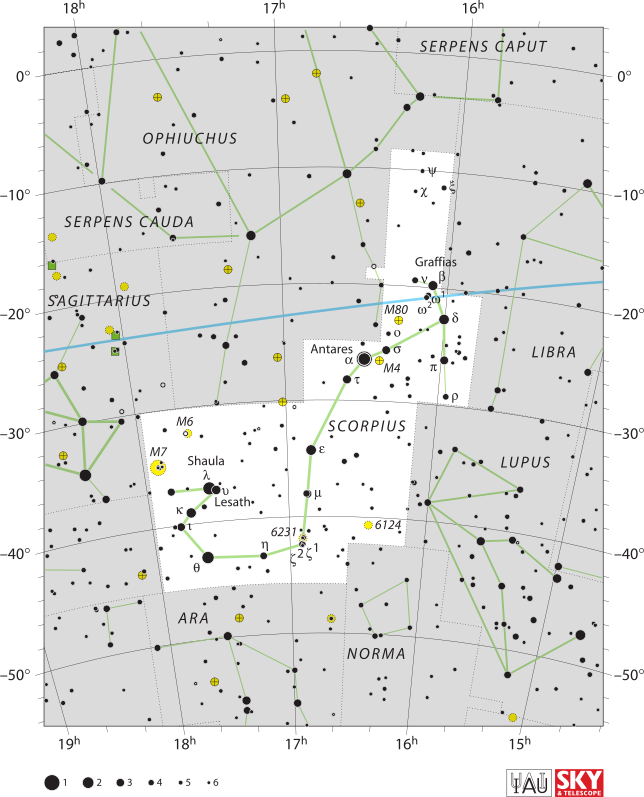
One of the tools built into this system was Scorpius. The constellation’s long curving tail with the hooked end is an obvious fishhook shape, and that’s what it became in Polynesian mythology: the hook Maui used to fish the islands up from the ocean floor. But the navigation is the interesting part. The Polynesians covered more than thirty degrees of latitude north to south, and over that range Scorpius doesn’t stay fixed relative to the horizon. The whole constellation tilts. Near the equator it climbs higher in the sky; further south it tips towards the horizon. The angle of the fishhook tells you where you are. The mythology is a mnemonic for a navigational technique, encoded in a story you can teach your children.
We in the West tend to equate technological sophistication with machines and flags. A culture that encodes stellar geometry into oral tradition, sails a triangle of ocean larger than the continental United States, and makes contact with South America a few centuries before Columbus is not less technically accomplished for having done it in a wooden canoe rather than a caravel. The tools were different. The precision was not.
The moai on Easter Island are striking and mysterious and generate a lot of tourism. The people who built them sailed there across open ocean, found an island that is genuinely almost impossible to locate without knowing exactly what you’re doing, and arrived with the agricultural knowledge to survive. That tends to get less attention than the statues. It probably shouldn’t.
Comments
Loading comments…
Leave a comment